

Subsea Field Joint Coating Services: Advanced Solutions for Long-Term Offshore Pipeline Protection
Offshore pipelines are highly important assets that convey oil, gas, and other resources over extensive subsea systems. Although these pipelines are usually fabricated using high-performance protective coatings, the welded joints formed during installation need further protection to ensure continuity of the coating and long-term service life. This is where Subsea Field Joint Coating Services come in as a crucial element.
The field joints are normally termed as the most vulnerable sections of an offshore pipeline because it is exposed in the process of welding and installation. These areas may serve as points of entry to corrosion, coating degradation, and structural weakness without proper protection. New technologies in advanced field joint coating can be used to ensure that the protection of the entire pipeline system is uniform and contributes to the stability of the work and the longevity of the assets.
Why Field Joint Protection Matters in Offshore Pipelines
The coating system applied in the factory of a pipeline gives it great resistance to corrosion on the body of the pipe. Nevertheless, when the individual pipe sections are welded offshore, the coating around the join has to be replenished to ensure that it is fully covered.
The inappropriate protection of field joints can result in:
- Accelerated corrosion
- Water intrusion under the coating.
- Reduced structural integrity
- Increased maintenance costs
- Costly repair campaigns
- Reduced operational lifespan
With the increase of offshore developments to more challenging and deeper conditions, joint protection has become an important part of contemporary offshore engineering.
Understanding Field Joint Coating Systems
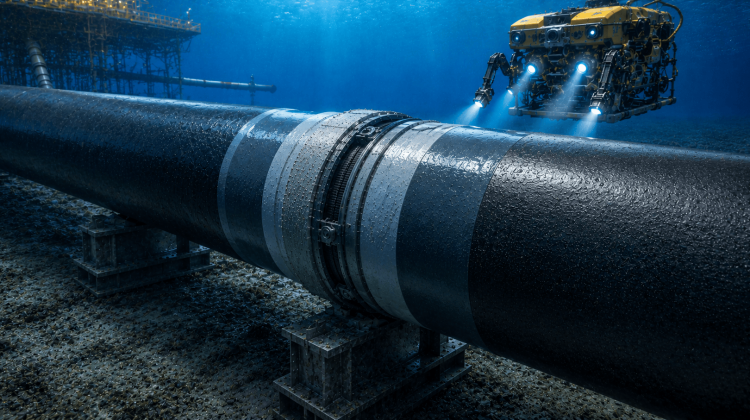
Field joint coating systems are highly engineered systems that are used to cover welded sections and blend with factory-applied coatings. These systems form an uninterrupted corrosion-free layer on the pipeline surface.
Field joint coating has the following main goals:
- Corrosion prevention
- Mechanical protection
- Thermal insulation continuity
- Seawater resistance.
- Long-term coating performance
In recent times, the development of coating technologies has been made to resist the most extreme offshore environments, such as high pressure, changes in temperature, and mechanical load.
Common Technologies Used for Pipeline Weld Joint Coating
Depending on the requirements of the project and environmental conditions, there are numerous coating technologies that have been widely used to offer protection to offshore pipeline welds.
Heat Shrink Sleeve Systems
The heat shrink sleeves are still one of the most widely used in the applications of Pipeline weld joint coating. Such systems are made of polymer based sleeves, which are tightly wrapped around the area welded when heated.
Key advantages include:
- Fast installation
- Excellent adhesion
- Strong corrosion resistance
- Proven offshore performance
Liquid Epoxy Coating Systems
Epoxy coatings create a smooth protective coating in direct contact with the weld line. They give superior bonding and durability in marine conditions.
Benefits include:
- Superior corrosion resistance
- Excellent bonding characteristics
- Adaptability with various coating systems.
- Long service life
Polyurethane Protective Coatings
Polyurethane systems are more flexible, have more abrasion resistance, and are suitable to use in offshore projects where there may be mechanical impacts and seabed interaction.
The Role of Subsea Weld Joint Protection in Asset Reliability
Welded joints can be the most problematic areas of a subsea pipeline system. Effective Subsea weld joint protection is used to avoid localized corrosion and coating failures, which may undermine overall asset performance.
Efficient safeguards measures help in:
- Improved operational safety
- Reduced inspection frequency
- Extended pipeline lifespan
- Lower maintenance costs
- Enhanced environmental compliance
Through installation vulnerabilities, the operators will be able to save a lot of money in repair and intervention costs in the future.
Offshore Pipeline Corrosion Protection: A Multi-Layered Approach
The use of coating is not the only thing about modern Offshore pipeline corrosion protection. It integrates several technologies to formulate an all-inclusive defense mechanism against corrosion and environmental degradation.
Major protection strategies are:
High-Performance Coating Systems
High-tech coatings form a layer that does not allow seawater, oxygen, and chemicals to penetrate the steel surface.
Cathodic Protection
Impressed current systems and sacrificial anodes offer extra resistance to corrosion through the regulation of electrochemical reactions.
Integrity Monitoring Programs
Frequent inspection aids in detecting coating damages and corrosion hazard prior to its becoming a serious issue.
The combination of these measures contributes to the reliability and performance of pipelines in the long term.
Emerging Trends in Offshore Field Joint Protection
New technologies are changing the field of the joint coating industry as offshore projects continue to get more complex.
Rapid-Cure Coating Materials
Further developed formula enables quicker installation without affecting protective performance, shrinks project schedules, and decreases vessel prices.
Automated Application Technologies
Automated coating systems enhance quality and consistency and reduce human error in offshore installation.
Enhanced Thermal Insulation Solutions
Deepwater developments commonly need coating that offers thermal protection and corrosion protection to ensure the assurance of the flow.
Smart Inspection Technologies
ROVs and sensors allow conducting thorough investigations of field joint coating during the lifecycle.
Pipeline Integrity Management and Long-Term Asset Performance
Effective offshore operations require additional coating application. Good Pipeline integrity management is one that provides pipelines with a safe and reliable lifespan in their operation.
A robust integrity program would normally consist of:
- Risk-based inspections
- Corrosion monitoring
- Non-destructive testing (NDT)
- Maintenance planning
- Asset performance assessments
- Regulatory compliance reviews
Together with high-quality, field joint coatings, integrity management programs can be used to optimize the life of infrastructure and operational efficiency.
Frequently Asked Questions (FAQs)
Q1. What are subsea field joint coating services?
They are special coating applications aimed at protecting welded areas on offshore pipelines following installation to provide continuous corrosion resistance and coating integrity.
Q2. What makes field joints susceptible to corrosion?
Welding and installation of field joints expose the joints to seawater, which in turn leads to corrosion unless well guarded.
Q3. What is the use of pipeline weld joint coating?
Coating of welding joints in pipelines revitalizes protection coatings around the welded sections to eliminate corrosion, which reduces the long-term wear and tear of pipelines.
Q4. What are the benefits of field joint coating systems?
They allow penetration of moisture to be avoided, minimize the risks of corrosion, and provide protection throughout the pipeline structure.
Q5. Why is pipeline integrity management important?
Integrity management assists in tracking pipeline status, detecting risk, maintenance planning, and avoiding failures that may pose threats to safety and operations.
Conclusion
The offshore pipelines have one of the worst environments of operation in the world, and thus, protection of the welded connections is a top priority. Subsea Field Joint Coating Services can be used through the development of advanced coating technologies, innovative installation procedures, and proactive maintenance techniques to achieve long-term offshore pipeline protection and to maintain operational stability.
The trend of offshore projects being expanded into deeper water and more difficult environments makes high-performance field joint solutions, as well as extensive integrity management programs, critical in maximizing asset life, minimizing lifecycle costs, and maintaining safe and efficient operations.