

Offshore Diving & Coating Services: Advanced Underwater Inspection, Corrosion Protection and Asset Integrity Solutions
Some of the most challenging places on Earth are where offshore structures are used. The pipelines, platforms, jetties, and other subsea structures can be gradually corroded due to constant exposure to seawater, hydrostatic pressure, marine growth, strong currents, and corrosive elements. Energy companies rely on Offshore Diving & Coating Services, which combine underwater inspection, corrosion protection, structural maintenance, and innovative repair solutions to ensure safe and efficient operations.
The contemporary offshore diving activities go way beyond the eye test. Current commercial divers are collaborating with remotely operated vehicles (ROVs), digital inspection technologies, and high performance coating systems to ensure that offshore infrastructure is maintained with minimum downtime and throughout the lifecycle of the assets. These combined services are critical towards offshore oil and gas production, construction of marine infrastructure, renewable energy development, and port infrastructure all over the world.
Why Offshore Diving Services Are Essential
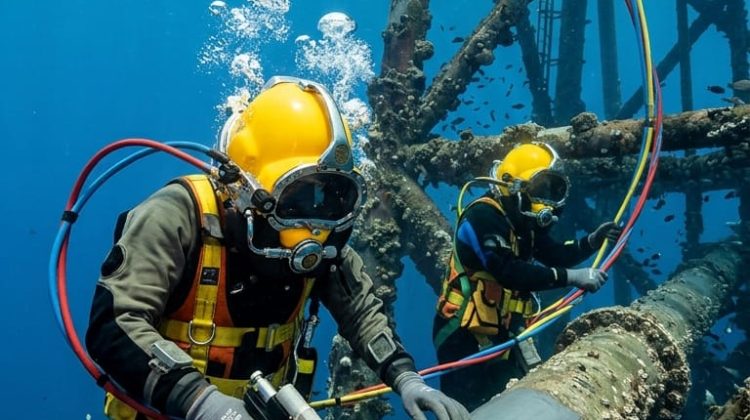
Submarine infrastructure cannot be easily reached, and thus regular inspections and maintenance are a complicated engineering task. Direct access to the underwater assets that cannot be inspected at the surface is offered by offshore diving specialists.
Examples of offshore constructions that need diving support are:
- Offshore platforms
- Subsea pipelines
- Risers
- Ship hulls
- Mooring systems
- Jetties and piers
- Subsea manifolds
Periodic underwater intervention will assist in the detection of defects at an early stage, minimizing the chances of equipment malfunction, environmental accidents, and the high cost of emergency repairs.
Underwater Inspection Services for Early Defect Detection
The basis of a good offshore maintenance policy is Professional Underwater Inspection Services. Thorough inspections enable the operators to assess the state of assets at sea before it becomes a significant issue in the operation.
Some of the modern methods of inspection are:
Commercial Diver Visual Inspections
Certified divers make close inspections of offshore structures within a short range to find corrosion, coating damage, cracks, marine growth, and mechanical defects.
ROV-Assisted Inspections
The ROTA vehicles, which are fitted with high definition cameras, sonar, and laser measurement systems, increase the accuracy of the inspection process and make the operations even safer.
Non-Destructive Testing (NDT)
High-level testing technologies like ultrasonic thickness testing, magnetic particle inspection, and eddy current testing are used to assess the structural integrity with ease and do not cause any harm to the asset.
The interplay between the expertise of the diver and the latest inspection technologies offers the most accurate information on the condition that will be used in making informed maintenance planning.
Marine Protective Coating Systems for Long-Term Performance
The use of Marine Protective Coating Systems developed specifically to apply to the submerged environment is one of the best ways of preventing offshore corrosion.
Such coating systems usually comprise:
Surface Preparation
Removal of marine growth, corrosion products, and contaminants provides correct adhesion of the coating and longevity.
Protective Primers
Primers are attached to steel surfaces with the ability to avoid moisture intrusion and the onset of corrosion.
High-Performance Barrier Coatings
The use of high-tech epoxy and polyurethane finishes produces tough protective finishes that can resist prolonged exposure to seawater.
Abrasion-Resistant Topcoats
Topcoats also offer extra protection against mechanical wear, water currents, and environmental wear.
Effective coating systems can greatly help in reducing maintenance and increased the life of the infrastructure.
Subsea Corrosion Protection Strategies
One of the major reasons that leads to deterioration of offshore infrastructure is corrosion. Effective Subsea Corrosion Protection is a combination of several technologies to protect the important assets.
Typical security measures are:
- Fusion Bonded Epoxy (FBE) coatings
- Polyurethane protective coatings
- Cathodic protection systems
- Sacrificial anodes
- Corrosion monitoring sensors
- Periodic underwater inspections
The combination of protective coating with cathodic protection and regular checkups enables operators to minimize corrosion rates and enhance long-term reliability.
Commercial Diving Services Beyond Inspection
Modern Commercial Diving Services underpin a vast array of underwater engineering and maintenance services.
Typical services include:
- Underwater welding and cutting
- Pipeline repairs
- Coating application and restoration
- Cathodic protection installation
- Structural reinforcement
- Marine growth removal
- Salvage and recovery activities
- Subsea equipment installation
The specialized services enable the maintenance work to be carried out effectively with minimal production downtimes.
Offshore Asset Integrity Management Through Integrated Solutions
Offshore infrastructure does not need periodic checks to maintain. Effective Offshore Asset Integrity Management incorporates the capabilities of engineering practices, digital technologies, and preventive maintenance into an overall asset protection strategy.
Core elements include:
- Risk-based inspections
- Corrosion monitoring
- Structural assessments
- Maintenance scheduling
- Fitness-for-service evaluations
- Regulatory compliance
- Digital asset monitoring
This combined system helps operators to maximize maintenance budgets as well as enhance safety and operation reliability.
Emerging Technologies Transforming Offshore Diving Operations
The offshore industry is still embracing new technologies that enhance efficiency, safety, and accuracy of inspections.
Robotics and Hybrid Inspection
Autonomous underwater vehicles (ROVs) and autonomous underwater vehicles are used to conduct inspections of structures that are hard to reach, together with commercial divers.
Digital Twin Technology
Virtual models are used to simulate the behavior of infrastructure and enable engineers to anticipate the need to perform maintenance before a failure can be experienced.
Artificial Intelligence
AI-based analytics process and interpret inspection data to identify a corrosion pattern and schedule maintenance.
Advanced Underwater Coating Materials
The new-generation coating offers a higher degree of adhesion, quicker curing, and better environmental performance under submerged environments.
Such innovations are assisting offshore operators to enhance the reliability of their assets and minimize the cost of intervention.
Frequently Asked Questions (FAQs)
Q1. What are offshore diving & coating services?
Ans: They encompass underwater inspections, application of protective coatings, corrosion control, structural repair, and maintenance works carried out by qualified commercial divers.
Q2. What is the reason why underwater inspection services are important?
Ans: Periodic inspection assists in the detection of corrosion, coating damage, cracks, and structural defects prior to their progression into a major failure.
Q3. How does subsea corrosion protection work?
Ans: It is used to integrate protective coatings, a cathodic protection system, corrosion tracking, and planned maintenance to inhibit underwater corrosion.
Q4. What do marine protective coating systems mean?
Ans: They are customized multi-layer coating systems that offer protection against seawater, corrosion, and mechanical damage of offshore steel structures.
Q5. What is the aim of offshore asset integrity management?
Ans: It maintains offshore infrastructure to be safe, reliable, compliant, and operational through inspections, monitoring, maintenance, and engineering evaluations.
Conclusion
Due to the growing complexity of offshore operations, the security of subsea infrastructure involves a mixture of technical skills, new inspection technologies, and innovative systems of corrosion protection. Professional Offshore Diving and Coating Services offer the full solutions to the inspection, maintenance, repair, and preservation of offshore assets that are being utilized in severe marine environments.
Offshore operators can enhance the life of the infrastructure, save on maintenance, enhance safety, and ensure long-term reliable performance of the infrastructure by incorporating underwater inspections, protective coating systems, corrosion mitigation measures, and proactive management of asset integrity across offshore oil and gas, marine construction, as well as energy projects.
