

Offshore Underwater Pipeline Coating: Latest Protection Methods for Long-Term Marine Asset Integrity
The offshore energy sector requires a stable offshore system to sustain the unbroken operations and environmental safety. Submarine pipelines are constantly exposed to marine growth, salt water, pressure variations, and chemical corrosion. These assets may decay very fast without advanced protection systems, thus incurring costly repairs, loss of production, and operational risks.
That is why Offshore Underwater Pipeline Coating is now one of the most important investments of modern offshore engineering. The current coating technologies not only prolong the lifespan of pipelines but also enhance structural integrity, performance, and longevity of marine assets.
Why Subsea Pipelines Require Advanced Protective Coatings
Subsea pipelines have one of the worst working industrial environments on earth. The persistent contact with the sea waters, oxygen, chlorides, and the variant temperatures promotes the corrosion of the metals. Pipeline structures can further be compromised in deepwater settings by the hydrostatic pressure and external mechanical forces.
The modern underwater coating systems assist operators to attain:
- Long-term corrosion resistance
- Reduced maintenance costs
- Enhanced compliance with offshore safety.
- Enhanced pipeline durability
- Improved thermal insulation.
- Less risk of environmental pollution.
Due to the increasing offshore projects in the more demanding and deep waters, there is an increasing need of effective marine pipeline corrosion protection solutions.
Latest Protection Methods Used in Offshore Pipeline Systems
Fusion Bonded Epoxy (FBE) Coating
Fusion Bonded Epoxy has continued to be a popular protective system for subsea infrastructure. This thermoset polymer lining is bonded to steel surfaces and offers good resistance to moisture intrusion and corrosion.
The use of FBE systems is common in:
- Offshore oil and gas pipelines.
- Subsea transportation networks
- Marine structural components
- Deepwater flowlines
It is very efficient in long-term prevention of corrosion under water because of its durability and adhesion qualities.
Polypropylene Coatings and Three-layer Polyethylene (3LPE).
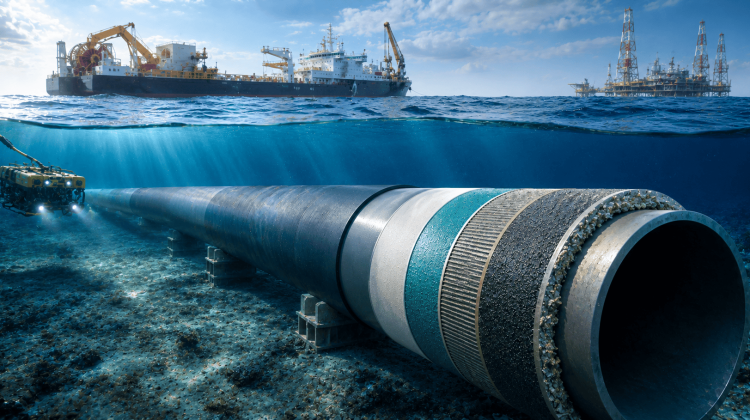
Three-layer coating systems are made by using epoxy primers, adhesive layers, and outer protection of polyethylene or polypropylene. They have good mechanical strength and chemical resistance.
Benefits include:
- Superior impact resistance
- Increased disbondment protection on the cathode side.
- Long operational lifespan
- Great abrasion resistance in the sea.
Many marine pipeline coating specialists recommend 3LPE coatings for offshore assets operating in aggressive environments.
Subsea Field Joint Coating Services
Although the main body of the pipes is covered by factory-applied coating, the welded joints need to be treated further during offshore construction. This is where Subsea Field Joint Coating Services are needed.
Field joint coating systems preserve the weld areas against corrosion and exposure to the environment and provide continuation of the coating over the pipeline system.
New field joint technologies are now available:
- Heat shrink sleeves
- Liquid epoxy systems
- Polyurethane-based coatings
- Joint protection systems that are heated by induction.
Field joints used properly contribute greatly to better reliability of the subsea pipeline and fewer repair needs in the long term.
Importance of Offshore Weld Joint Protection
Underwater pipelines have the weakest points in welded connections. Unprotected joints may be a starting point of corrosion spread, structural weakness, and coating failure.
Good Offshore Weld Joint Protection assists operators:
- Maintain coating integrity
- Prevent localized corrosion
- Improve pipeline lifespan
- Reduce inspection frequency
- Increase the safety of offshore operations.
Different coating systems that are specially designed to fit the areas to be welded can guarantee uniform performance even in deepwater conditions.
Emerging Trends in Offshore Anti-Corrosion Coating Technology
The offshore industry is moving towards smarter coating technology to enhance the accuracy of inspection and predictive maintenance.
The trending innovations are:
Self-Healing Coatings
These sophisticated systems are able to automatically repair small surface damages, which assists in the reduction of corrosion formation and prolongation of assets.
Thermal Insulation Coatings
Thermal protection is commonly used in modern subsea projects to ensure flow assurance. Coatings of thermal insulation are used to minimize the heat loss and avoid hydrate formation in offshore pipes.
Environmentally Friendly Coating Materials
Sustainability is emerging as an issue in offshore engineering. Low-VOC and environmentally compliant Offshore Anti-Corrosion Coating solutions are now being shifted by many companies.
Robotic Underwater Application Systems
Underwater inspection and coating maintenance is increasingly being done with remote-operated vehicles (ROVs), which help increase precision and minimize human risk.
Role of Offshore Pipeline Integrity Management
The use of protective coatings is not sufficient to ensure the longevity of pipelines. The combination of coating systems and regular inspection, cathodic protection, monitoring technologies, and preventive maintenance planning are all components of effective offshore pipeline integrity management.
An all-encompassing integrity strategy involves:
- Corrosion monitoring
- Coating inspection surveys
- Pipeline risk assessment
- Non-destructive testing (NDT)
- Preventive maintenance scheduling
Offshore operators can significantly lower the lifecycle costs and operational risks by combining new coating systems and proactive integrity management.
Choosing the Right Underwater Protective Coating Solution
The choice of the right Underwater Protective Coating is also determined by various operational factors such as:
- Water depth
- Pipeline temperature
- Chemical exposure
- Installation method
- Mechanical stress conditions
- Project lifespan requirements
The subsea coating contractors who have extensive experience in this field consider these factors keenly in order to propose the best protection system to be used in every offshore project.
FAQs
Q1. What is offshore underwater pipeline coating?
Ans: It is a special protective system used on subsea pipelines to avoid corrosion, mechanical damage, and environmental degradation of marine environments.
Q2. Why is subsea pipeline coating important?
Ans: Coating of subsea pipelines serves to extend the life of the pipeline, cut down on maintenance expenses, enhance safety and eliminate failure of structure due to corrosion of seawater.
Q3. Which are the most used pipeline coating materials offshore?
Ans: Fusion-bonded epoxy (FBE), polyurethane coating, three-layer polyethylene (3LPE), polypropylene coating, and liquid epoxy system are common materials.
Q4. What is the principle of operation of offshore pipeline anti-corrosion coating?
Ans: These finishes provide a protective layer and keep the seawater, oxygen, and chemicals away from the steel surface to reduce corrosion and metal wear.
Q5. What is field joint coating in an offshore pipeline?
Ans: Field joint coating is also used to protect the welded areas of pipelines following offshore installation to provide continuous corrosion protection to the entire pipeline system.
Conclusion
With the offshore operations shifting towards deeper and more challenging marine conditions, superior coating technologies are becoming a necessity in ensuring long-term protection of these infrastructures. Innovative field joint solutions and fusion-bonded epoxy systems are just a few of the ways that modern Offshore Underwater Pipeline Coating techniques are vital in ensuring the reliability, operational efficiency, and environmental safety of subsea assets.
Those companies that have invested in high-performance subsea protection systems and proactive integrity management plans are in a better position to minimize the cost of maintenance, enhance the operational uptime, and maximise the life of valuable offshore assets.